111.bzRequest a proposal

AI data centers where more power reaches the chips.

An AI accelerator runs on about one volt and draws over a thousand amperes. At that current, every centimetre of copper, every conversion and every fan costs money. We design, equip and launch modular data centers that keep those losses small, from the grid connection to the chip.

Request a proposal

Send your workload, location and available power.

Where the electricity goes
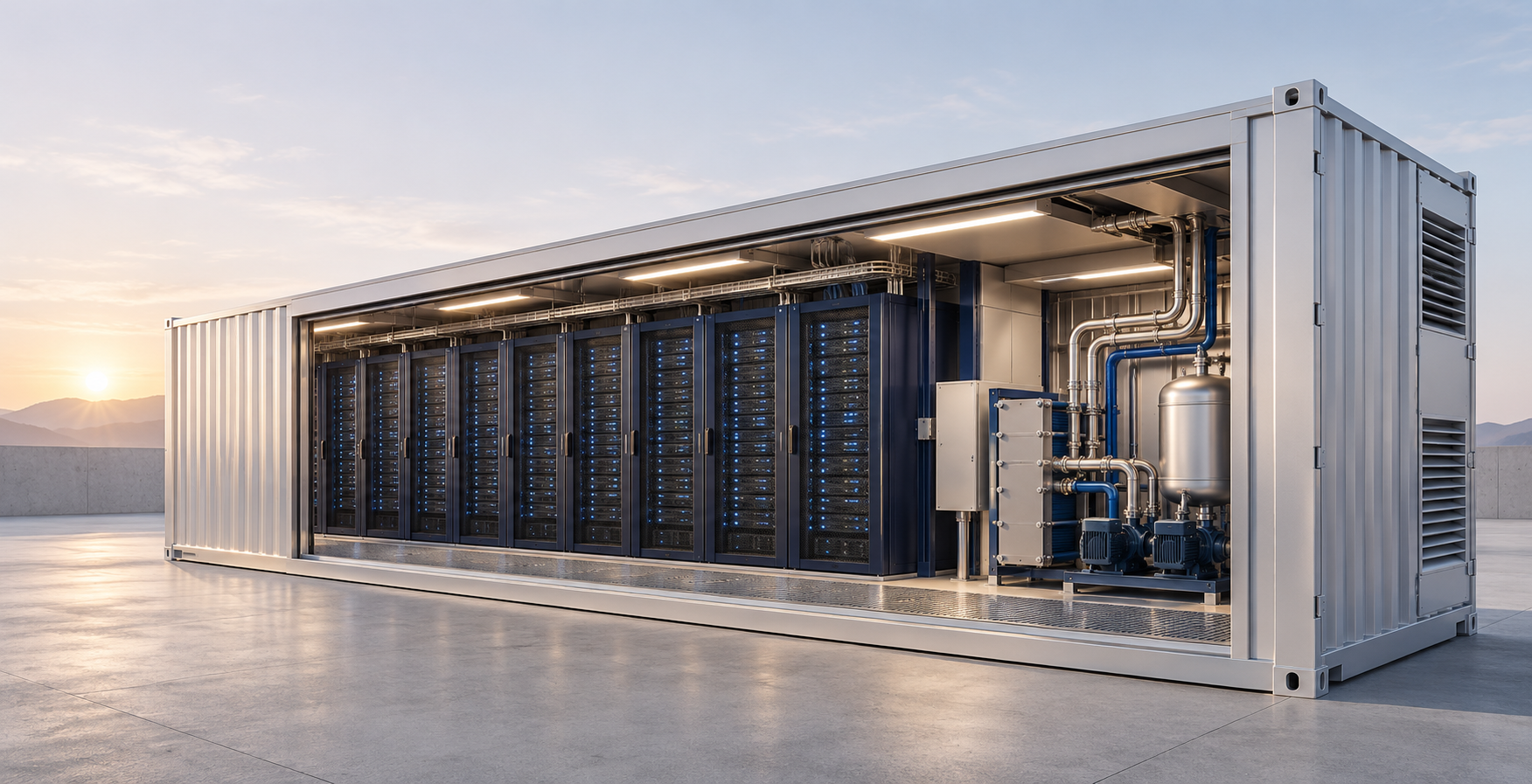
Illustration of a modular data center with server racks and cooling equipment

You pay for every kilowatt at the meter. The chips use only what reaches them.

On the way from the grid, electricity passes through transformers, cables, converters, busbars and regulators. Each turns part of it into heat, and the cooling then spends more power removing that heat.

One rule explains most of the losses

Think of electricity as water in a hose: voltage is the pressure, current is the flow. A wire heats up from the flow, and the heat grows with its square. Twice the current gives four times the heat; ten times the current, a hundred times.

A laptop processor draws tens of amperes; an AI accelerator, well over a thousand. So carry power at high voltage and low current for as long as possible, and step down to one volt as close to the chip as the hardware allows.

The same 1.5 kW for one accelerator, at each stage of the path
  1. 10,000 V0.15 AGrid connection
  2. 400 V4 AModule and rack feed
  3. 48 V31 ARack busbar
  4. ≈1 V1,500 AThe last millimetres to the chip

Voltage falls, current rises. The heat is in the high-current stretch, so we keep it as short as the hardware permits.

What we do at each stage

  1. Bring high voltage close

    Grid power arrives at medium voltage. We place the transformer next to the module, so the thick low-voltage cables stay a few metres long.

  2. Convert fewer times

    Each AC–DC conversion turns a few percent of the power into heat, and a conventional facility converts several times before power reaches a server. Where the hardware allows, we feed racks with direct current and put the batteries on the same DC bus, removing stages.

  3. Raise the rack voltage

    A 48-volt busbar carries the same power as a 12-volt one with a quarter of the current and about one sixteenth of the heat loss. The newest AI racks move to several hundred volts DC. We design for the highest voltage your servers accept.

  4. Shorten the last centimetres

    Chip makers now put the final step down to one volt directly under the processor or inside its package, so the thousand-ampere current travels millimetres. We weigh power delivery when we choose servers and accelerators.

  5. Keep copper and silicon cool

    Copper resists more as it warms, and a hot chip leaks current that does no work. Liquid cooling keeps chips and busbars cooler and replaces server fans, which commonly take 10–15% of an air-cooled server's power.

  6. Set power limits per job

    The last few percent of an accelerator's speed cost a disproportionate amount of energy. In a published study of AI training, capping GPU power cut energy use by about 12–15% while jobs ran a few percent longer. We agree limits per workload with your team.

  7. Meter every stage

    Meters from the grid connection to the rack give every lost kilowatt an address, so the next upgrade goes where it pays most.

What one percent is worth

Take a module with 1 megawatt of computing load. One percent of losses is 10 kilowatts around the clock, about 87,600 kilowatt-hours a year. At $0.10 per kilowatt-hour, each percentage point costs roughly $8,800 a year for the life of the facility. Losses are set in the design, before the hardware is bought, and that is when we remove them.

Get an estimate for your site

One project, from specification to launch.

We start with the workload and the power available at your site. We design the module, select servers and networking, and plan power delivery and cooling as one system.

Then we assemble, install, integrate and commission. You receive a data center ready for your workload, with new hardware or compatible servers you already own.

Tell us about your project

More ways the design lowers the bill.

Before buying hardware, we price the finished work at the quality, latency and availability you need.

Put the climate to work

In a cool climate the outer cooling circuit runs on outdoor air for more of the year, with the chillers off. We weigh it with power price, connection time, network, logistics and data-location rules, for your site or a shortlist of locations.

Sell or use the heat

Server heat can warm a nearby greenhouse, building or heat network. We compare its temperature, schedule and distance with the cost of pipes, heat pumps and upkeep. The heat offsets heating bills or is sold under contract; on days when nobody takes it, the module rejects it on its own.

Run flexible work when power is cheap

Critical services keep full capacity. Batch jobs with a deadline run when power is cheaper or more plentiful. An idle accelerator can cost more than the electricity it saves, so the schedule accounts for utilization and service commitments.

Restore capacity before the repair

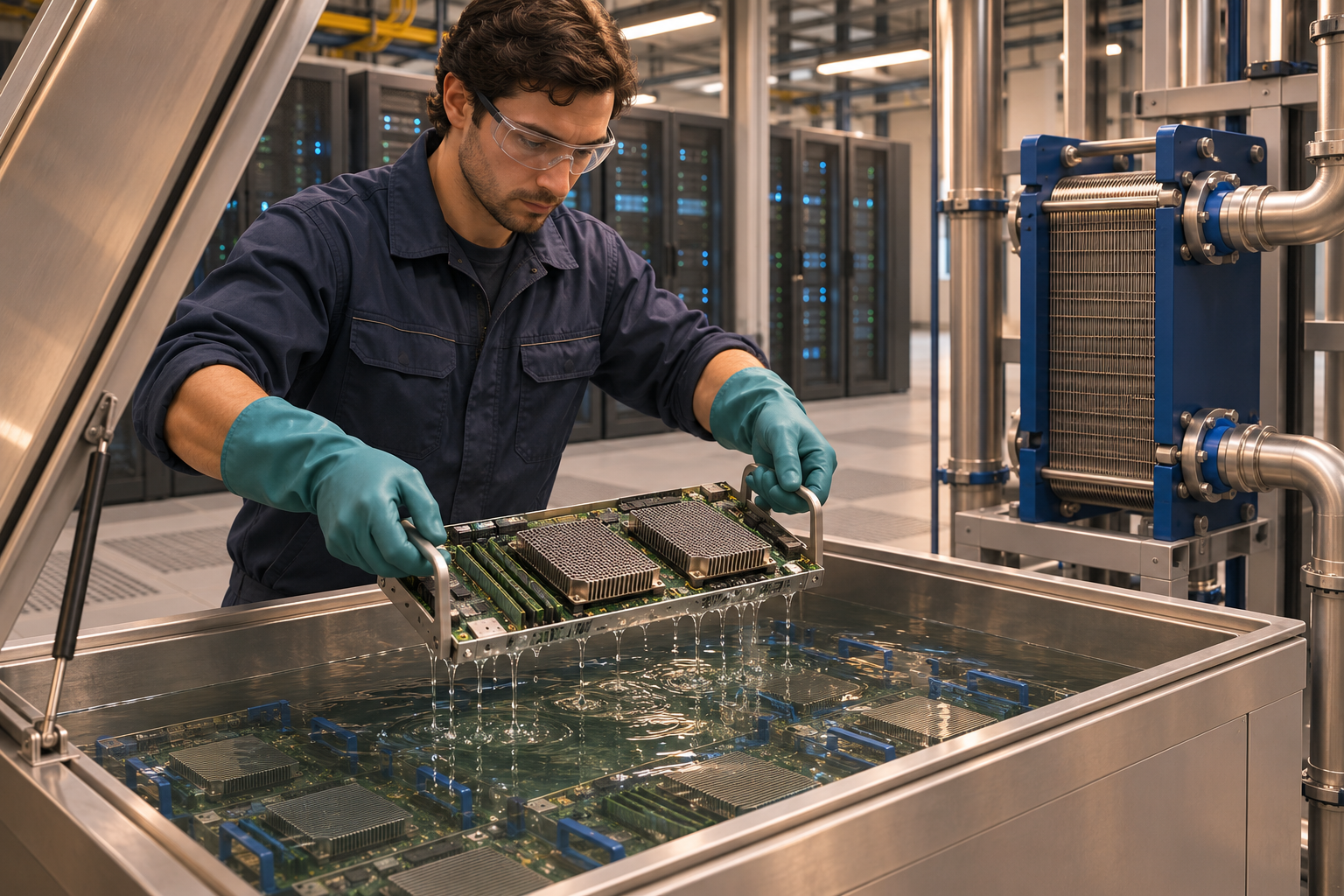
Server carriers get lifting points, accessible connectors, labels and a clear removal path. When a node fails, its jobs move elsewhere, it powers down and a manipulator swaps it for a tested spare; in an immersion tank the node drains first. Engineers repair the removed node separately, so capacity is back before the repair is done.
Why put servers in liquid?

AI hardware turns almost all of its power into heat. Immersion cooling carries it away in a liquid that does not conduct electricity.

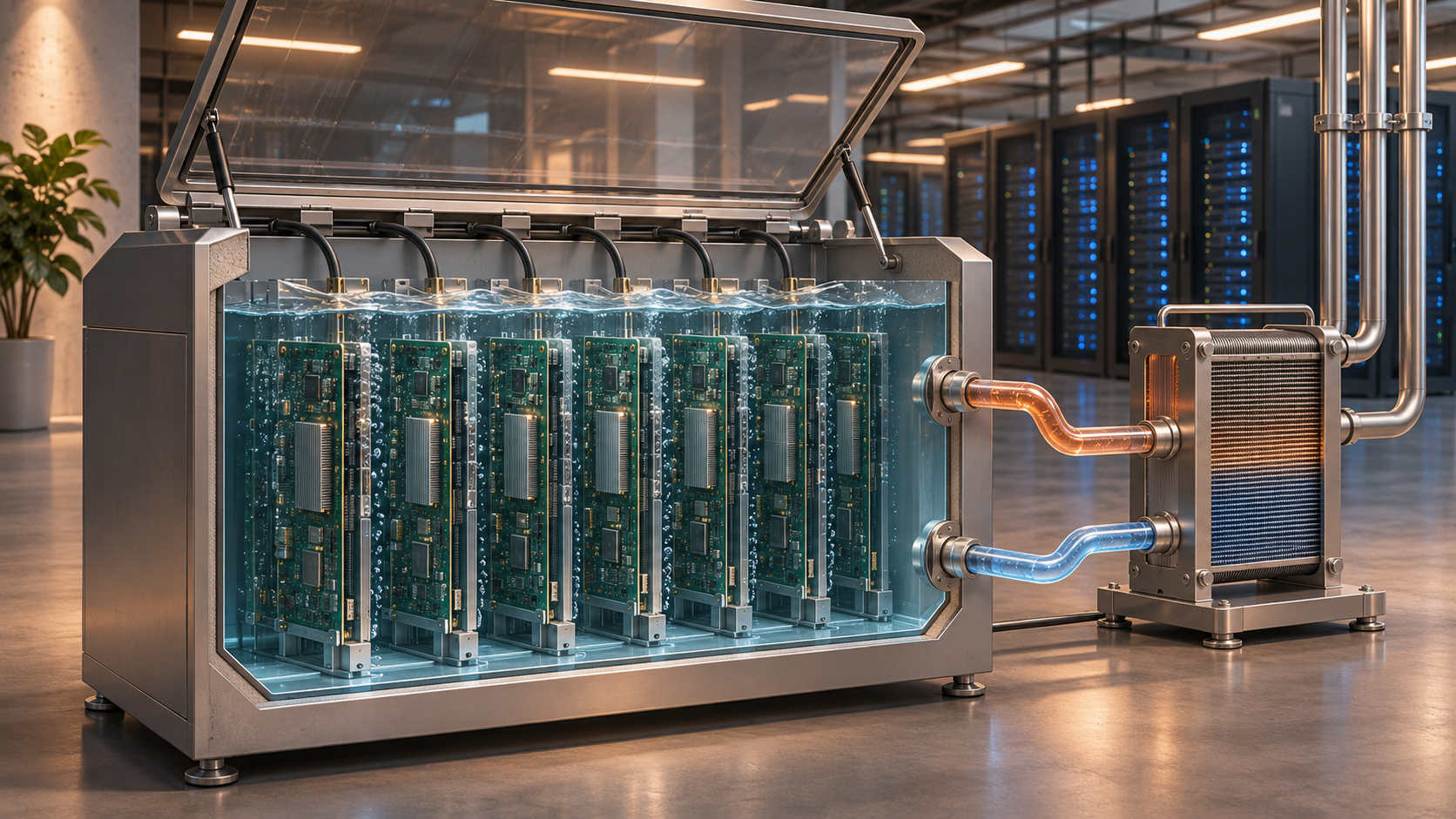
Illustration of server boards in an immersion cooling tank connected to a heat exchanger

The servers sit in dielectric fluid. A separate circuit carries the heat outdoors.

How it works

The cooling circuit

The liquid carries heat from the servers to a heat exchanger. An outdoor circuit rejects the heat or sends it to heat recovery. In a single-phase system the liquid never boils. Pumps, exchangers, coolers and monitoring are sized with the tank for the installed equipment.

More capacity in less space

As rack power grows, fans struggle to move enough air. Liquid carries heat away from densely packed equipment, so more computing fits on the same floor, and the pumps use less power than the fans they replace.

Immersion or direct-to-chip?

Direct-to-chip cooling runs liquid through cold plates on the hottest chips and leaves the rest of the server on air. For new accelerators with vendor-supported cold plates, it is often simpler to service. Immersion suits other hardware and dense installations. We choose by the cost of the finished work on your hardware.

Installation and maintenance

Fans, cables and thermal materials are checked against the fluid and replaced where needed. The design covers pump and temperature monitoring, fire protection and safe fluid handling. We confirm warranty terms with the vendor before servers go into the tank.

Planning a data center?

Send the workload, location, available power, capacity and timeline, and say which jobs can wait for a deadline. We reply with a configuration and a proposal: where the power goes, what it costs and what we would change.

Request a proposal
Illustration of a technician servicing a server in an immersion cooling tank

Let’s talk about your project.

One message is enough to start.